死体泥棒と墓掘り人:ダブリンの暗い墓地の歴史
Long before Dublin's graveyards became peaceful historic landmarks, they were places of fear, secrecy and opportunity. During the height of the body-snatching trade, a newly buried corpse could be worth more outside the grave than inside it. Resurrection men crept through burial grounds after dark, while gravediggers, watchmen and grieving families tried to protect the city's dead.
For anyone searching for a gravedigger bus tour in Dublin, the true history is every bit as disturbing as the ghost stories. Discover why bodies were stolen, how graves were defended and how Dublin's medical schools became connected to one of the darkest trades of the eighteenth and nineteenth centuries.
Who Were Dublin's Gravediggers?
A gravedigger had a necessary and generally legitimate role. Gravediggers prepared burial plots, lowered coffins into the ground and maintained cemeteries and churchyards. In an age when most of this work was completed by hand, it was demanding physical labour carried out in all weather and often in overcrowded burial grounds.
Because they understood the layout of a graveyard, knew which graves were new and could recognise disturbed soil, gravediggers were also well placed to notice attempted grave robberies. Some worked alongside cemetery watchmen to protect recent burials. The words gravedigger, grave robber and body snatcher are sometimes used as if they mean the same thing, but historically there was an important difference.
- Gravediggers buried and protected the dead.
- Grave robbers stole from burial places.
- Body snatchers removed human remains.
- Resurrection men supplied bodies for dissection.
The term “resurrection man” gave the trade an almost supernatural name. These men did not bring anybody back to life; they “resurrected” the newly buried by taking them out of the ground.

Why Did Body Snatching Become Common in Dublin?
Dublin developed a strong reputation for medical and surgical education during the eighteenth and nineteenth centuries. Anatomy was essential to that education. A surgeon could not properly understand the human body from drawings alone, so teachers and students needed cadavers for practical study and dissection.
The problem was supply. The number of bodies legally available for anatomical examination was far below the number wanted by a growing collection of medical schools, hospitals and private anatomy teachers. That shortage created a market, and wherever there was demand, resurrection men were prepared to meet it.
Freshly buried bodies were particularly sought after because decomposition made anatomical study increasingly difficult. News of a funeral could therefore attract unwanted attention. A recent grave belonging to someone without the money for strong protection was especially vulnerable.
This history also reveals an uncomfortable social divide. Wealthier families could pay for guards, secure burial plots or stronger physical protection. Poorer people were more likely to be buried in crowded or less secure grounds, leaving their graves easier to reach. Even in death, poverty could determine how well a person was protected.
Who Were the Resurrection Men?
Resurrection men were the middlemen of the body-snatching trade. Some were professional grave robbers, while others were reportedly connected to medical education themselves. Their customers were not looking for jewellery or valuables; they wanted bodies that could be used to teach anatomy.
The work usually took place at night and often involved more than one person. One member of the group might watch for gravediggers, soldiers, cemetery guards or relatives while the others disturbed the burial. The body then had to be removed from the area and delivered without attracting attention.
Although the trade was secretive, it could not have existed without buyers. The resurrection men carried out the raid, but the shortage within medical education gave the stolen remains a financial value. This connection between scientific progress and the violation of graves is what makes the history so unsettling: respectable lecture rooms depended, at least in part, on what happened in graveyards after dark.
How Did Body Snatchers Remove a Body?
Popular films often show grave robbers digging up an entire coffin. In reality, speed and concealment were vital. A full excavation would create too much noise, take too long and leave an obvious mound of disturbed earth.
Body snatchers could instead expose only part of a coffin, break through it and remove the corpse using ropes or hooks. The burial clothes and personal possessions might be left behind. This was partly practical, but it also reflected the strange legal position surrounding the trade: a corpse was not treated as ordinary property in the same way as clothing, jewellery or the coffin. Disturbing a grave could still be punished, but stealing possessions risked an additional and clearer theft charge.
Once the body had been removed, the soil, flowers and other surface details could be replaced. From a distance, the grave might appear untouched. A family could believe that their loved one was resting below, unaware that the coffin had been violated during the night.
Bully's Acre: A Target for Dublin's Body Snatchers
One of the locations most closely associated with body snatching in Dublin is Bully's Acre in Kilmainham. Also known historically as the Hospital Fields, it was an ancient burial ground beside the Royal Hospital Kilmainham. It became an important burial place for poorer Dubliners and was used long before the modern cemetery system developed.
The burial ground's accessibility, crowded conditions and comparatively limited protection made it attractive to resurrection men. Contemporary accounts connected bodies used in Dublin dissecting rooms with the Hospital Fields. Soldiers from the nearby Royal Hospital and graveyard watchmen were alert to the threat, particularly because military comrades were among those buried there.
That created the possibility of violent confrontation. A body-snatching party caught inside a burial ground could find itself pursued by armed or determined guards. For resurrection men, the darkness that concealed their work also made every movement, voice and approaching light a possible warning.
The Strange Story of Dan Donnelly
Bully's Acre is also linked to one of Ireland's most remarkable body-snatching stories. Celebrated bare-knuckle boxer Dan Donnelly died in 1820 and was buried in the cemetery. Soon afterwards, grave robbers reportedly removed his body and delivered it to a surgeon for anatomical study.
When Donnelly's admirers discovered what had happened, they demanded the return of his remains. According to the story, most of the body was recovered and reburied, but the surgeon retained Donnelly's right arm for medical examination. The preserved arm later passed through several owners and exhibitions, turning an act of grave robbery into one of the strangest stories in Irish sporting history.
Donnelly's fame made the disappearance of his body noticeable. Countless other victims of the resurrection men had no large group of supporters to search for them, meaning many stolen bodies were probably never recovered.
How Gravediggers and Families Protected the Dead
The fear of body snatching changed the way people approached burial. The danger was greatest immediately after a funeral, so families sometimes watched a grave until decomposition made the body less valuable to anatomists. Cemeteries employed guards, and gravediggers inspected recent burials for signs that the ground had been disturbed.
Different protective measures were used across Ireland and Britain:
- Night watchmen patrolled burial grounds.
- Families guarded recent graves.
- High walls restricted cemetery access.
- Watchtowers improved views at night.
- Heavy coverings protected new burials.
Glasnevin Cemetery, which opened in 1832, still bears evidence of this fear. Its high perimeter walls and watchtowers were intended to help deter body snatchers. These surviving features show that the threat was not simply a tale invented for later ghost stories. It shaped the design and security of real Dublin burial grounds.
Were Body Snatchers Breaking the Law?
The law surrounding human remains was disturbingly unclear. Under the common law of the period, a dead body was not regarded as property in the ordinary sense. That did not make body snatching legal: those responsible could be prosecuted for disturbing a grave, trespass, damaging a coffin or stealing items buried with the deceased.
However, the lack of a straightforward theft charge for taking the body itself created a loophole that resurrection men attempted to exploit. This is why some gangs were careful to leave clothing and valuables behind. The distinction seems grotesque today, but it mattered to people trying to reduce the punishment they might face if caught.
The legal uncertainty also reflected a wider problem. Medical science required bodies, but the system had not developed an ethical and sufficient way to provide them. The result was a trade operating between legitimate medical institutions and criminal activity.
Burke and Hare: Body Snatchers or Murderers?
No history of nineteenth-century grave robbing is complete without mentioning William Burke and William Hare. Both men were Irish, but their notorious crimes took place in Edinburgh rather than Dublin.
Burke and Hare are often described as body snatchers, although they did not become infamous by digging up graves. Instead, they murdered people and sold the bodies for anatomical dissection. Murder avoided the hard work and danger of entering guarded cemeteries while producing fresher cadavers—but it turned an already horrifying trade into something even worse.
The scandal caused enormous public outrage and strengthened calls to reform the way bodies were supplied for medical study. Burke was convicted, executed in 1829 and publicly dissected. Hare gave evidence and escaped prosecution, after which his fate became uncertain.
How the Anatomy Act of 1832 Changed the Trade
The Anatomy Act of 1832 introduced a regulated system for anatomical examination across Great Britain and Ireland. It allowed licensed anatomy teachers to receive certain unclaimed bodies and permitted people to donate bodies for medical study, subject to the rules set out in the legislation.
By increasing the legal supply of cadavers, the Act removed much of the market that had supported professional resurrection men. It did not erase public fear overnight, and the legislation itself raised serious ethical questions about how the bodies of poor and unclaimed people were treated. Nevertheless, it marked the beginning of the end of widespread body snatching for medical schools.
The trade left a permanent mark on Dublin. Graveyard walls, watchtowers and stories passed down through generations all recall a period when burial did not necessarily guarantee rest.
Discover Dublin's Body-Snatching & Gravedigger Stories on the Ghostbus
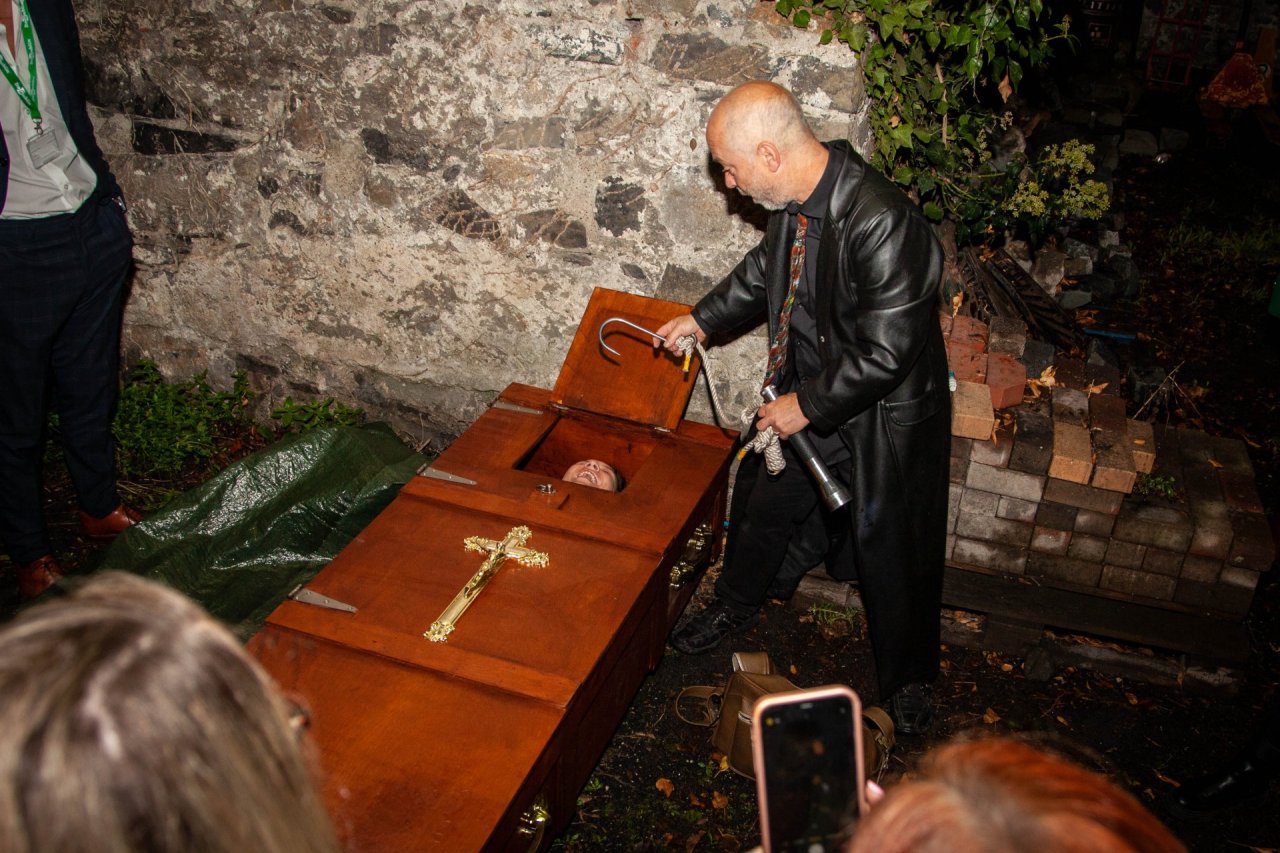
If this history has you searching for a gravedigger bus tour in Dublin, step aboard DoDublin's original Ghostbus Tour. The experience takes passengers into the darker side of the capital through tales of grave robbers, body snatchers, sinister characters and haunted locations.
This is more than a standard Dublin bus tour. Professional actors bring the stories to life aboard a specially designed bus with winding corridors, sinister rooms and a Victorian-style theatre on its upper deck. The approximately two-hour experience also includes atmospheric stops away from the bus, including a hidden city-centre graveyard and the historic surroundings of St Audoen's Church in Dublin's medieval quarter.
What to Expect on the Ghostbus
- Dublin's original Ghostbus experience
- Professional actor-led storytelling
- Gruesome body-snatching history
- Atmospheric off-bus locations
- Dark comedy and scares
Rather than simply listing names and dates, the Ghostbus places these stories inside an atmospheric night-time experience. History, theatre, comedy and horror come together as Dublin's grave robbers and darker characters are brought back into the light.
Ready to uncover Dublin's darker side? Book the Gravedigger & Ghost Bus Tour and discover why the city's history can be more frightening than fiction.
Frequently Asked Questions About Dublin's Gravediggers and Body Snatchers
-
What was a resurrection man?
A resurrection man was someone who removed recently buried bodies and supplied them for anatomical study. The name came from the idea that the person was being “raised” from the grave, although the purpose was dissection rather than resurrection.
-
Were there body snatchers in Dublin?
Yes. Body snatching was a genuine problem in Dublin during the eighteenth and early nineteenth centuries. The city's medical schools needed cadavers for anatomy teaching, and burial grounds such as Bully's Acre became associated with the illegal trade.
-
What is the difference between a gravedigger and a body snatcher?
A gravedigger was employed to prepare graves and bury the dead. A body snatcher or resurrection man secretly removed bodies after burial. Gravediggers could actually play an important role in detecting disturbed graves and protecting cemeteries from robbers.
-
Did body snatchers steal valuables?
The primary objective of resurrection men was the body rather than jewellery or clothing. Because possessions were clearly recognised as property, stealing them could lead to additional theft charges. Some body snatchers therefore left burial clothes and valuables behind.
-
Were Burke and Hare Dublin body snatchers?
William Burke and William Hare were Irish-born, but their crimes took place in Edinburgh. They became notorious for murdering victims and selling the bodies for dissection rather than taking corpses from Dublin graveyards.
-
Is there a gravedigger bus tour in Dublin?
Visitors searching for a Dublin gravedigger bus tour can experience stories of grave robbers and body snatchers aboard DoDublin's Ghostbus Tour. It combines professional actors, dark comedy, theatrical storytelling and visits to atmospheric locations around Dublin.
-
How long is the Dublin Ghostbus Tour?
The Ghostbus Tour lasts approximately two hours. Guests should check the official Ghostbus booking page for current departure times, availability and visitor information.